Fresh AI Tools & Digital Products You Should Explore

Hamza Techhamza_sukhiEdit Profile
The most interesting AI tools and digital products arriving or evolving in 2026 are changing what we expect software to do. Instead of waiting for users to move between separate apps, newer products are starting to take action, use connected services, and complete multi-step work. That shift is easy to miss if we only compare model names and benchmark scores. A better way to judge fresh AI tools is to ask a simple question: What can the product actually finish for us?
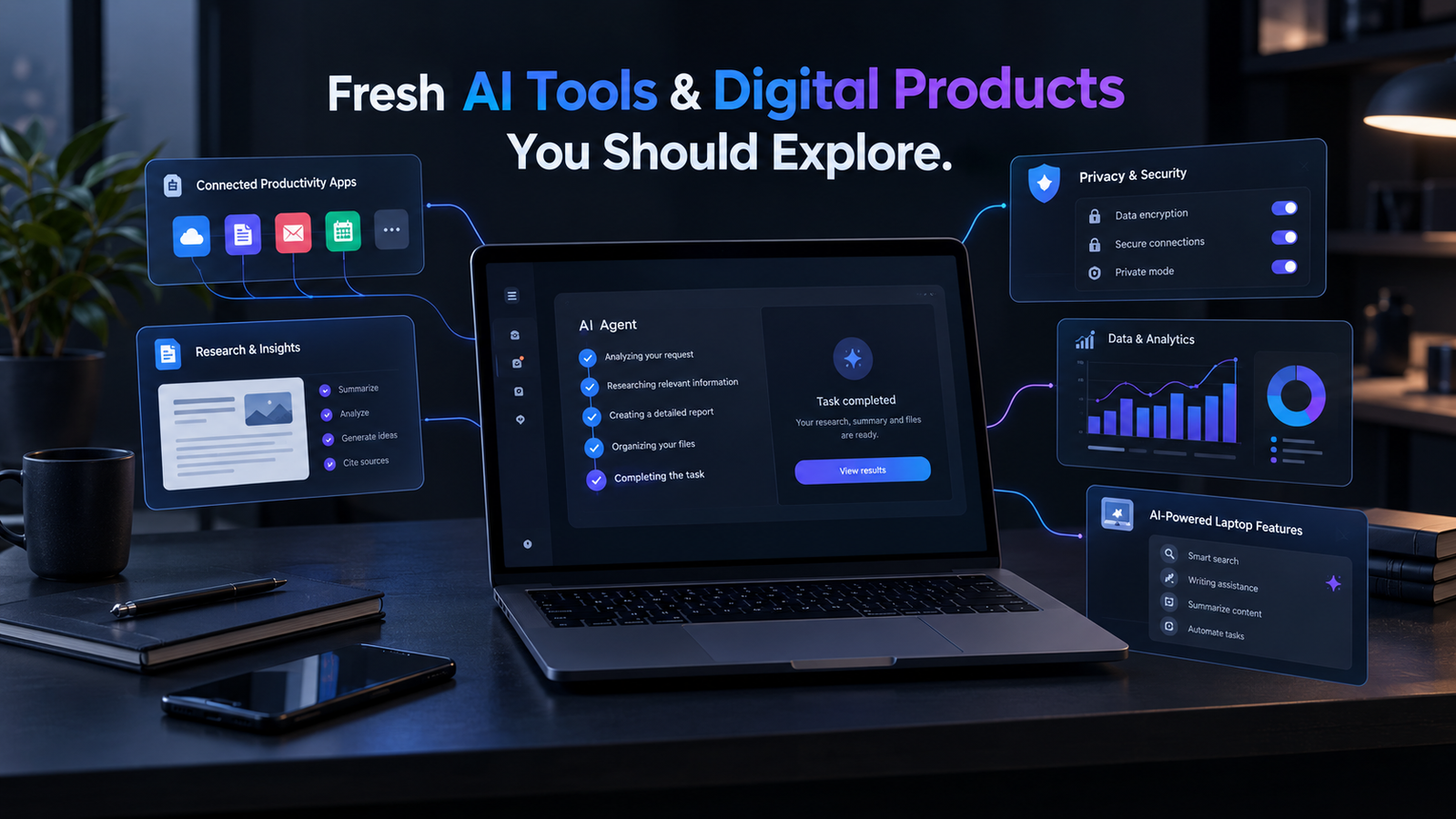
Recent launches show this change clearly. Meta introduced Muse in September as a personal AI agent that can work across connected apps. Google introduced Googlebook with Gemini intelligence built directly into the laptop experience. Anthropic has also expanded Claude beyond basic chat through Cowork and integrations with productivity applications. Proton has continued developing Lumo as a privacy-focused AI assistant with reasoning, web search, memory, and data visualization features.
AI Tools Are Moving From Answers to Actions
The biggest development in new AI tools is not another chatbot window. It is the move from generating information to completing tasks. Traditional AI assistants mainly respond to prompts. Newer agentic products are increasingly designed to plan, use software, work with files, access connected services, and continue working through several steps. This is also changing how we should evaluate AI software. Instead of asking only how good an answer looks, it makes more sense to ask how much useful work the product can complete with appropriate user control.
Meta Muse Shows Where Personal AI Is Going
Meta introduced Muse on September 8, 2026, describing it as a personal AI agent designed to do work rather than simply answer questions. Meta says Muse can handle tasks such as sending emails and booking travel, open a browser, fill out forms, and work toward larger goals. It can also continue working after a user closes the app and return when it needs approval or when something changes.
Muse runs inside a dedicated Muse Secure VM, which contains the agent and a user’s data. Meta says a separate Sentinel system controls whether Muse can reach the internet. Sensitive actions, such as sending an email or making a purchase, require user approval, and Muse provides an audit trail of its actions.
Meta also says Muse can use Link by Stripe for checkout, with a one-time-use card designed to keep the user’s real payment details hidden. Muse is rolling out in the US on iOS, Android, and muse.ai, with availability planned for AI glasses.
For readers exploring AI agent platforms, this is an important development because it shows how AI agents are moving beyond conversation toward controlled execution.
For example, an AI that creates a travel plan is useful. An AI that can research the trip, organize the details, fill out forms, and complete approved bookings is a different kind of product.
Fresh AI Tools Are Becoming Complete Workspaces
Another important change is the blending of AI with traditional productivity software.
Anthropic’s Claude ecosystem is a good example. Claude Cowork brings agentic capabilities to broader knowledge work, while Claude has expanded into applications such as Excel and PowerPoint. Anthropic says Claude can work across Excel, PowerPoint, Word, and other productivity workflows, allowing context to move between applications instead of forcing users to copy information manually.
Claude in Excel can work with spreadsheets, while Claude in PowerPoint can help create presentations. Anthropic has also described workflows where information can move from Excel into PowerPoint, reducing the traditional copy-and-paste process between applications.
Cowork is also being used for longer-running tasks. Anthropic’s June 2026 Economic Index reported that Claude usage increasingly includes long-running agentic tasks through Claude Code and Cowork, showing how AI use is moving beyond simple conversational prompts.
This matters because users no longer need to think of AI as a separate window beside their normal software. The AI is becoming part of the workspace itself.
That creates practical possibilities for writers, students, marketers, analysts, and business teams. Instead of asking an AI for text and then manually moving that content into another application, more of the workflow can happen inside connected tools.
Readers interested in comparing current AI models can also look beyond model benchmarks and examine how those models are being turned into complete products.
Googlebook Brings AI Into the Laptop
AI is also moving deeper into computer hardware.
Google introduced Googlebook, a laptop designed around Gemini intelligence. Google says Googlebook combines ChromeOS foundations with Android technology and puts Gemini directly into the device experience. The company announced pre-orders on September 21, 2026.
One of its notable features is Magic Pointer. Google says the feature understands text, images, and context and brings Gemini into the area where the user is working. Google also highlights voice dictation and other built-in intelligence features designed to help users complete tasks more directly from the laptop.
The larger trend is important. AI is increasingly becoming a layer across operating systems and devices rather than a destination that users have to open separately.
Instead of asking, “Which AI website should I use?”, users may increasingly interact with AI directly through their laptop, browser, phone, or other connected hardware.
Privacy Is Becoming a Feature Worth Checking
The rush toward AI agents creates another issue that many tool lists overlook: how much access does the product need?
An AI that can read email, browse websites, remember information, access files, and make purchases needs more permission than a basic writing assistant. That makes privacy controls part of the product’s practical value.
Lumo from Proton provides an example of this approach. Proton describes Lumo as a privacy-focused AI assistant and says it does not use user data to train its AI models. Lumo 2.0, released in June 2026, added advanced reasoning, image generation, deep web search, and long-term memory.
In January, Proton also introduced Projects, giving users encrypted spaces for chats, files, and requirements connected to a particular task.
Then, on August 3, 2026, Proton added data visualization capabilities. Lumo can now create charts, graphs, and other visuals from spreadsheets, reports, and internal documents. Proton says the feature is designed to keep the information private while turning data into useful visual insights.
For anyone testing AI products, we should check three things before uploading sensitive material:
- What data can the tool access?
- Is our data used for model training?
- Can we remove connected accounts or stored information?
These questions can matter more than a small difference in model performance.
How to Find the Best AI Tools 2026 Has to Offer
The phrase best AI tools 2026 can be misleading because the right tool depends on the job.
A better approach is to test products against a real task.
Use a Three-Step Test
First, give the tool one complete task.
Do not judge it only from a demo prompt. Ask it to produce something you would actually use.
Second, measure the work left afterward.
If an AI generates a report but requires heavy correction, its headline feature may save less time than expected.
Third, check the limits.
Look at usage caps, export options, connected services, privacy settings, and whether important features require a paid plan.
This approach is especially useful because AI products are changing quickly. A tool that was limited six months ago may now offer agents, file analysis, visual creation, memory, or deeper integrations.
For current information about AI products and models, the OpenAI API pricing page provides official product and pricing details.
Digital Products Worth Watching Beyond Chatbots
The newest products are spreading into areas that used to require separate software.
We are seeing AI agents, AI-native browsers, research tools, coding agents, privacy-focused assistants, AI workspaces, and AI-enabled hardware appear across the market.
Research-focused products are also becoming more capable. Tools such as NotebookLM show how AI can work with user-provided sources instead of relying only on general chatbot responses. This makes source-based AI useful for people who need to research documents, reports, notes, and other material.
Coding is another major area of development. AI coding products are increasingly moving from simple code generation toward planning, editing, debugging, and working across larger projects.
The same broader shift can be seen in AI automation platforms. Products increasingly combine models with tools and workflows so they can perform several connected actions instead of producing one response.
That does not mean every launch deserves attention. Many new products are experiments, beta services, or narrow tools. The better signal is whether a product removes a real step from an existing workflow.
A small tool that saves 30 minutes every day can be more useful for a particular user than a powerful AI system that they rarely use.
What Makes a Fresh AI Tool Worth Trying?
A useful way to evaluate fresh AI tools is to look at five practical areas.
Task Completion
Can the product finish a meaningful task, or does it only generate suggestions?
Integration
Can it work with the services, files, and applications you already use?
Reliability
Does it produce useful results consistently, or does every output require extensive checking?
Privacy and Control
Can you control its permissions, review its actions, delete stored information, and understand how your data is handled?
Cost and Limits
Does the free or paid plan provide enough usage for the actual workload?
These factors make a better evaluation framework than simply choosing the product with the newest model.
AI Agents Are Becoming More Practical
The growth of AI agents is one of the clearest themes in 2026.
Meta’s Muse can work across connected services and perform approved actions. Anthropic’s Cowork is designed for longer-running knowledge-work tasks. Other AI automation products are also moving toward workflows where AI can use tools rather than simply answer questions.
This does not mean traditional apps are disappearing.
Instead, AI may increasingly become the layer that connects existing applications. An agent could read information from one service, process it, create something in another application, and ask for approval before taking an important action.
For users exploring AI automation tools, this distinction is important. The value is not simply having an AI model. The value comes from what the model can safely do with the tools around it.
Conclusion
The most interesting AI tools and digital products in 2026 are not simply producing better answers. They are reducing the number of steps between an idea and a finished task. Meta Muse shows this through personal AI agents that can take approved actions. Googlebook shows how AI can become part of the computer itself. Anthropic is bringing agentic capabilities into knowledge work and productivity applications, while Proton is combining AI capabilities with a privacy-focused approach.
That makes task completion, privacy, integration, reliability, and control useful measures when exploring new products. As AI moves into documents, browsers, phones, laptops, and connected services, we should explore new products by asking what work they remove from our day. That is the opportunity in the current wave of fresh AI tools: not simply finding software with the biggest feature list, but finding products that can remove unnecessary steps from a real workflow.
FAQ About Fresh AI Tools and New AI Tools
What are fresh AI tools?
Fresh AI tools are newly launched products or established products with major new AI features. A tool does not have to be brand new to be worth exploring. A meaningful feature update can change how useful it is.
What should we look for in new AI tools?
Look for real task completion, useful integrations, clear privacy controls, reliable output, and reasonable usage limits. Avoid choosing a tool simply because it uses a newer model.
What are the best AI tools 2026 users should try?
There is no single best tool for everyone. The right option depends on the task. AI agents may help with automation, AI workspaces may help with documents and presentations, research tools can support source-based work, and privacy-focused assistants may matter more when handling sensitive information.
Are AI agents replacing normal apps?
Not completely. Current products show a gradual shift toward AI controlling or working across existing services. Access, permissions, compatibility, reliability, and user trust still shape what these systems can actually do.
Why are AI tools becoming more connected?
Connected AI tools can reduce the need to move information manually between applications. Instead of generating an answer and stopping there, an agent can potentially use files, applications, browsers, and other services to complete multiple steps with appropriate user approval.